Baltimore Piano Moving Guide: Safe, Fast, Flat-Rate Service in 2026

What Baltimore piano movers need to handle before moving day
A piano is not just another heavy item. An upright runs 300–500 pounds and a grand is heavier still, with a shape that shifts weight unpredictably the moment it tips. Most damage happens on the route, not in the truck: a doorway two inches too narrow, a rowhome stair turn that won't clear the leg, a loading dock that closes at 5 p.m. That's why crews planning a piano move price and staff it differently than a standard household job, where moveBuddha's Baltimore movers guide puts the local average around $110 per hour for a two-person crew.
This guide walks through planning and measurements, building access, how to compare a flat-rate quote, safe handling for upright versus grand pianos, and backup plans for the obstacles Baltimore throws at you.
Before you call anyone, gather:
- A tape measure, and the piano's height, width, and depth
- Photos of the piano plus every doorway, stair, and turn on the route
- Building or HOA contact details, including certificate of insurance requirements
- A reserved elevator window if you're in a high-rise or apartment building
- A realistic time window, not a single hard hour
Confirm whether you have an upright or a grand — the handling plan and crew size change. And if closing dates slip or the new place isn't ready, climate-controlled storage keeps the instrument out of a garage.
Step 1: Measure the piano, the route, and the building rules
Before you call for a quote, collect the numbers. Measure the piano's length, width, and height, then note anything that sticks out — pedal lyre, legs, music desk, and lid height on a grand. A spinet and a 7-foot grand are different jobs, and the size of the instrument is one of the main things that sets flat-rate pricing, along with stairs or a lawn carry and travel distance.
Next, measure the path. Write down the width of every doorway the piano passes through, the narrowest point in each hallway, the depth of any stair landing where the crew has to pivot, and the door and cab dimensions of the elevator. Then measure the distance from the curb to the front door, because a long carry across grass or a broken sidewalk changes crew size and time on site.
Then check the building. Rowhome stairwells in Federal Hill and Canton behave differently than a high-rise on Light Street, and apartment buildings usually have their own rules: a move-in window, a required elevator reservation, freight elevator access only, and a certificate of insurance naming the property manager before anyone touches the loading dock. Ask the management office for that paperwork list in writing — it is the single most common reason a booked move day stalls.
Note whether the route has stairs, tight corners, a threshold drop, or a carry from the street. Baltimore movers price these as real variables, not afterthoughts.
Finally, take photos and a short video: each side of the piano, the doorway, the stairs from top and bottom, and the walk from the curb. Send them with your measurements. Any crew you hire should be able to confirm the route and crew size from that before move day.
Outcome: a written measurement sheet, a photo set, and a building rule list you can hand to any mover for an accurate quote.
Step 2: Compare flat-rate quotes and the costs that change the final price
Ask every company for a written flat-rate quote that itemizes the job instead of a single lump number. A usable quote separates the base move, the travel charge, stair or long-carry fees, and any special handling — crating, hoisting, or leg removal on a grand. When those lines are visible, you can compare two bids honestly; when they aren't, you're comparing guesses. The expected outcome of this step is two or three written estimates you can line up side by side.
Know the levers that actually move the price. Walker Movers, a regional piano specialist, builds its flat rates from three parts: the size and type of the piano, whether there are stairs or a lawn carry, and the travel distance. Those same three factors drive most quotes from piano movers in Baltimore, which is why the measurements and access notes from Step 1 belong in your first phone call — a spinet up four rowhome steps and a 7-foot grand out of a third-floor walk-up are not the same job.
Then ask what's bundled in. Confirm in writing whether the price covers padding and stretch wrap, disassembly and reassembly, board or skid equipment, crew size, and the actual cargo and liability coverage limits — plus what a certificate of insurance for your building costs and how long it takes to issue.
Sanity-check the number against the local market. moveBuddha's Baltimore guide puts standard local crews around $110 an hour for two movers, and piano work runs above that because it takes more people and specialized gear. A bid far under that range usually means something was left out; a bid far over it should come with a specific reason, like a hoist or a crane.
Step 3: Move upright and grand pianos safely
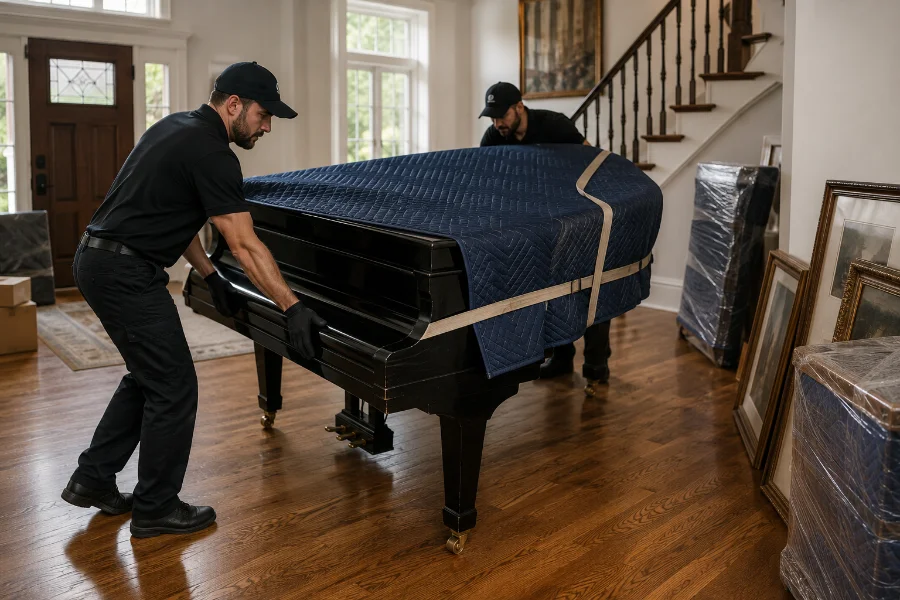
Treat the two piano types as two different jobs. An upright carries most of its weight high and toward the back, so it usually travels as one assembled unit: keyboard lid closed and secured, casters checked, the whole body wrapped in moving blankets and strapped to a four-wheel piano dolly or skid board. Expected outcome — the case never takes weight on its legs or pedals, and the finish stays covered from the room of origin to the truck wall.
Prepare a grand before anyone lifts. The standard approach is to lower and remove the lid where practical, detach the lyre (the pedal assembly), take off the legs, and lay the instrument on its bass side on a padded piano board, then strap it down before it moves an inch. Reassembly happens at the destination, on a level surface, before the piano is rolled into place. Ask any crew you hire to walk you through that sequence out loud; if they can't, keep calling.
Insist on real crew size. Stairs, thresholds, and rowhome turns are where pianos get dropped, and a load that one or two people can technically shove across a flat floor still needs enough hands to control it on an incline — plus a spotter who does nothing but watch clearance. Baltimore movers working narrow stairwells should also bring door jamb protection, floor runners, and ramps rather than improvising.
Judge the crew on careful handling, not clock speed. A team that blankets the instrument, straps the load inside the truck, and braces against the wall is doing the part you'll notice six months later when the finish is still clean. The same discipline applies to the rest of the heavy list: safes, antiques, gym equipment, and custom-crated items.
Step 4: Plan for tight hallways, elevators, weather, and schedule changes
Walk the route twice before moving day — once from the piano to the front door, once from the truck to the front door — and write down a fix for every pinch point. Done right, nobody is making decisions while 500 pounds sits balanced on a dolly.
Tight hallways and sharp turns. Measure the narrowest doorway and the tightest corner, then compare those numbers to the piano's depth and height. Uprights usually clear by being rotated onto a padded piano board; grands typically travel with the legs and lyre removed and the body padded on its side. If a corner still won't take it, settle on the alternate route in advance — a rear stairwell, a wider service door, a different parking spot.
Elevators. Reserve the freight elevator in writing, confirm whether the building needs a certificate of insurance and when it's due, and ask management to pad the cab. Book a window outside tenant rush hours. Anyone hiring Baltimore apartment movers for a high-rise should treat that paperwork as part of the job, not an afterthought.
Weather. Rain and snow call for wrap plus moving blankets, plywood or ramps over soft ground, and a tarped path from door to truck. In summer heat, the goal is less time sitting in a hot trailer. Expect to have the instrument tuned after it settles in the new room either way.
Last-minute changes. Delayed closings, denied building access, and a crew arriving before the route is cleared are the three most common derailments. Ask your piano movers in Baltimore what happens in each case before you book — the answer should be a short-term hold, not a rescheduled truck.
Step 5: Decide when storage, specialty handling, or office relocation support is the better fit
Match the service to the job before you book, not after the truck is loaded. A straight point-to-point piano move is the simplest case; anything with a gap in the timeline needs a different plan.
Book climate-controlled storage when the destination isn't ready — a delayed closing, floor refinishing, or a few weeks between leases. Soundboards and pin blocks react to swings in humidity, so an unconditioned garage or a standard self-storage unit is the wrong holding spot. Express Movers lists climate-controlled storage on short or long terms alongside its piano and specialty work, and Johnson's Piano Moving, a Baltimore piano specialist operating since 1978, offers climate-controlled piano storage as well. Expect to confirm the hold period and the redelivery date in writing.
Flag every other heavy or fragile item in the same conversation. Safes, antiques, gym equipment, and pieces that need custom crating use the same crew skills and often the same trip, which keeps one job from turning into two.
Ask for commercial scheduling if the piano sits in a church, school, or office. Office relocation adds dock reservations, certificates of insurance, and freight elevator windows that residential jobs skip.
Consider a same-day move only when measurements, parking, and access are already confirmed. Compressed timing works when nothing is left to discover on arrival.
FAQ: What Baltimore piano customers usually ask before booking
Are uprights and grands priced and handled the same way?
No. An upright usually travels upright on a padded dolly with a two- to three-person crew. A grand is different work: the lid, pedal lyre, and legs come off, the body goes onto a padded skid board, and it rides on its side. That means more labor, more crating material, and often a larger crew — so expect a higher number on the quote.
What should a flat-rate quote actually include?
Ask for the piece in writing: piano size and type, stair or long-carry counts at both addresses, travel distance, padding and crating, and the crew size assigned. J.R. Walker Movers publishes a clear three-part breakdown — size, stairs or lawn carry, and travel — which is a fair template for comparing any bid. For context on hourly work, moveBuddha's Baltimore guide puts local crews around $110/hour for two movers, which helps you sanity-check a flat rate.
When does storage make sense, and is same-day delivery realistic?
Storage helps when closing dates slip, a renovation runs long, or the receiving room isn't ready. Pianos are sensitive to humidity swings, so climate-controlled storage matters more than square footage. Same-day is realistic for short in-city routes booked early, less so for a grand with stairs on both ends during peak weekends.
What belongs on the planning checklist?
Measure the instrument and every doorway, stairwell, and turn. Confirm parking and elevator reservations, building certificates of insurance, and any move-in windows — the paperwork that trips up apartment moves more than the piano itself. Then set a weather backup date.
The comparison that matters is narrow: route details, written quote terms, and crew setup. Get two or three Baltimore movers on record for all three, then book the one whose answers are specific. Request a written estimate from Express Movers.